Bordeaux Essentials
Bordeaux through family wine memories in Hong Kong, Singapore and Zurich, with the essentials of Left Bank vs. Right Bank, Bordeaux grapes, classifications and global influence.
.jpeg)
Bordeaux is one of the most influential wine regions in the world. Its grape varieties, blending traditions and classification systems have shaped fine-wine culture far beyond France.
Many of the grapes most closely associated with Bordeaux — especially Cabernet Sauvignon, Merlot and Cabernet Franc, along with smaller roles for Petit Verdot and Malbec — are now grown around the world. Newer wine regions have repeatedly looked to Bordeaux as a reference point for both grape selection and blending.
You can see that prestige in the châteaux themselves, in the prices commanded by the most famous bottles, and in the extraordinary level of attention Bordeaux generates among collectors. Few regions have created a comparable combination of history, mystique and global influence.
Our connection to Bordeaux through Asia
While we lived in Hong Kong, Angela worked for the well-known wine critic James Suckling and often hosted wine events in Asia. The goal at those events was to introduce wines from around the world to Asian clientele, and Bordeaux always had a special magnetism.
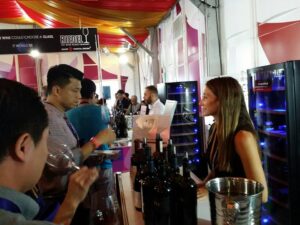
The region’s reputation was already deeply established, but growing demand from Asian collectors added another layer to the market for top Bordeaux. Prestige, scarcity and investment interest all reinforced one another.
The major Bordeaux red grapes
The red wines of Bordeaux are built primarily around a small group of grape varieties.
Cabernet Sauvignon brings structure, tannin, blackcurrant and ageing potential. Merlot contributes plum fruit, softness and body. Cabernet Franc can add perfume, freshness and herbal complexity. Petit Verdot is usually used in smaller proportions for color, tannin and spice, while Malbec now plays only a minor role in most Bordeaux blends.
Carménère is also historically permitted in Bordeaux, although it is rarely seen there today and became far more closely associated with Chile.
Left Bank and Right Bank
One of the simplest ways to understand Bordeaux is to divide it into the Left Bank and Right Bank.
On the Left Bank — including famous areas such as the Médoc, Pauillac, Margaux, Saint-Julien and Saint-Estèphe — blends tend to be dominated by Cabernet Sauvignon. These wines are often structured, tannic and built for long ageing.
On the Right Bank — particularly Saint-Émilion and Pomerol — Merlot usually plays the leading role, often supported by Cabernet Franc. These wines tend to be rounder and more immediately plush, although the best examples can age for decades.
The 1855 classification — and what “First Growth” really means
The famous 1855 Bordeaux Classification ranked many of the leading Médoc estates into five growths, with the top category known as Premier Cru Classé, or First Growth.
The five estates now recognized at that level are Château Lafite Rothschild, Château Latour, Château Margaux, Château Haut-Brion and Château Mouton Rothschild.
It is important not to use “First Growth” as a generic term for every great Bordeaux. Pétrus, for example, is from Pomerol, which has no formal classification system. Cheval Blanc is from Saint-Émilion and belongs to a completely different classification tradition.
Both are among the world’s most celebrated wines, but their prestige comes from reputation, history and quality rather than from the 1855 First Growth designation.
An unforgettable tasting before our move to Australia
Years ago, while we were living in Singapore and preparing to relocate to Australia, we learned that moving our finest bottles with us would be impractical because of the taxes and import costs involved.
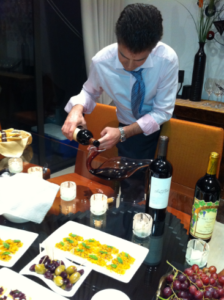
We had a few prized bottles of Bordeaux — including Pétrus and Cheval Blanc — and decided there was really only one sensible solution: drink them.
We held an unforgettable tasting in 2012, with Sean pouring some of the wines. It remains one of our most memorable wine evenings. We have had other opportunities to taste great Bordeaux since then, but very little has matched the extravagance of an evening created by the threat of an unacceptable import bill.
Bordeaux beyond the trophy bottles
The prestige end of Bordeaux is only part of the story. By 2021, Angela was running a wine club in Zurich, and we increasingly focused on lesser-known Bordeaux producers.
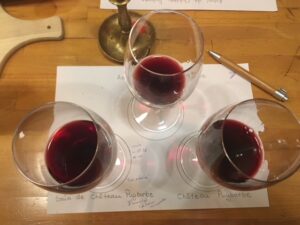
That is where Bordeaux can become especially interesting for normal wine drinkers. There are thousands of producers across the region, and many excellent bottles sit far below the price level of the famous classified growths.
Understanding Bordeaux therefore does not require chasing trophy wines. Learning the basic geography, the dominant grape varieties and the differences between producers can open up a huge range of quality at more accessible prices.
Why Bordeaux became the global benchmark
Bordeaux’s influence comes from several things working together: centuries of export history, famous estates, a clear classification culture, age-worthy wines, and grape varieties that proved adaptable around the world.
Cabernet Sauvignon and Merlot now appear everywhere from Napa Valley to Tuscany, Chile, Australia and South Africa. Bordeaux’s influence is visible every time a producer elsewhere builds a structured red blend around those grapes.
The Bordeaux Essentials video on this page gives the broader overview.
What to remember about Bordeaux
- Bordeaux is one of the world’s most influential fine-wine regions.
- The key red grapes are Cabernet Sauvignon, Merlot and Cabernet Franc, with smaller roles for Petit Verdot and Malbec.
- The Left Bank is generally more Cabernet Sauvignon-driven; the Right Bank is generally more Merlot-driven.
- The 1855 classification applies primarily to the Médoc and includes the famous First Growths.
- Pétrus and Cheval Blanc are legendary Bordeaux, but neither is a Médoc First Growth.
- Excellent Bordeaux exists far below the luxury end of the market; producer and appellation knowledge matter enormously.